What "human-written" even means now
If you have ever shipped a real feature with Claude Code or Cursor and then been asked whether you wrote it, you have felt how badly the old vocabulary fits. You made the architecture call, rejected most of what the agent proposed, untangled the payment integration it kept getting wrong, and reviewed every line. You also typed maybe a tenth of the final characters. So "did you write this code?" has no honest yes-or-no answer, because the question is built on an assumption that no longer holds.
Quick Answer
You cannot prove code is human written not AI by pointing at the code, because a generated file and a hand-written one are byte-for-byte indistinguishable once they exist. The question that can actually be answered is not "did a human type this?" but "did a human drive this?", and you answer it with provenance: the decisions, the iteration, the order things were built in, and an attributable record of which parts you steered versus delegated. In 2026 the credible move is not to deny AI involvement but to show your share of the work, traceable to source, captured as it happened. Below: why "I wrote it myself" no longer lands, what genuinely demonstrates human authorship, and the popular tells that prove nothing.
That assumption was simple and load-bearing: code existed because a person produced it, so the code was the proof of the person. For most of software's history that was safe. Working code with your name on it meant you wrote it, because writing it was the only path to it existing. AI severed that link. An agent now emits a coherent feature, a plausible commit trail, and a confident README in an afternoon, which means the presence of good code says nothing about who, or what, produced it. This is the real reason the demand for proof spiked. It is not anti-AI panic. It is that one of the most reliable signals in the industry quietly stopped being a signal.
So "human-written" has to be redefined to mean something checkable. Typed-by-a-human is neither verifiable nor interesting. Driven-by-a-human is both: it describes who made the decisions, caught the failures, and is accountable for the result. This is the shift that the whole question turns on, and the rest of this page assumes it.
Why you cannot detect it from the code itself
The first instinct is usually to look for tells in the code, and it is worth killing that instinct early because it wastes real effort. People reach for AI-detection tools, stylometry, or a gut sense that something "looks generated." Almost always, this fails, and it fails for a structural reason rather than a tooling gap.
Finished code carries no reliable fingerprint of its origin. A human can write in the same tidy, idiomatic style an agent produces, and an agent can be prompted into any style you like, including a messy one. AI-code detectors built on probability quirks are easy to defeat and produce false positives on perfectly human work, which is exactly the failure mode that makes them dangerous to rely on. You will often see someone confidently flag clean code as "obviously AI" when the author wrote every line, and the reverse just as often. Judging origin from the artifact is measuring the one thing that contains no usable information.
This is the same trap that catches commit volume and diff size. Lines changed stopped mapping to effort the moment agents could emit a thousand-line commit in seconds while a one-line fix follows an hour of your reasoning. Anyone trying to read authorship off how much code moved is reading noise. The signal was never in the output. It was always in the process that produced it, which is the part you have to capture deliberately because it does not survive in the finished file.
What actually demonstrates human authorship
Real evidence that you drove the work has properties a code snapshot never will, and the practical move is to build a record a skeptic can follow rather than hunt for one perfect artifact. These stack, and the more of them you have, the less any single one has to carry. Roughly from weakest to strongest:
- Keep the messy history, including the dead ends. Squashing your work into one clean commit deletes your best evidence. The revert, the three attempts at the same function, the commit message that says "ugh, wrong approach", is precisely what a single AI dump does not generate. In practice a history that shows struggle reads as human in a way a flawless one never will.
- Be able to explain any decision out loud. This is the oldest test and still the most decisive in a live conversation. If you drove the work, you can say why the auth flow is shaped the way it is, what you tried first, and what the agent got wrong. This is usually the point where pasted-without-understanding code collapses, no tooling required.
- Show the work around the code. The issues you opened, the design note, the pull request discussion, the bug you chased for two hours. Human authorship lives in this connective tissue, and the person who genuinely built something leaves a trail of thinking beside it that the person who did not cannot reconstruct after the fact.
- Capture the timeline passively, as it happens. A record of when the work occurred, in what sessions and at what cadence, captured automatically rather than written down later, is hard to back-date and hard to fake. This is the layer most developers skip, and it is the one that turns a story into evidence, because it is the part you cannot honestly recreate once the moment has passed.
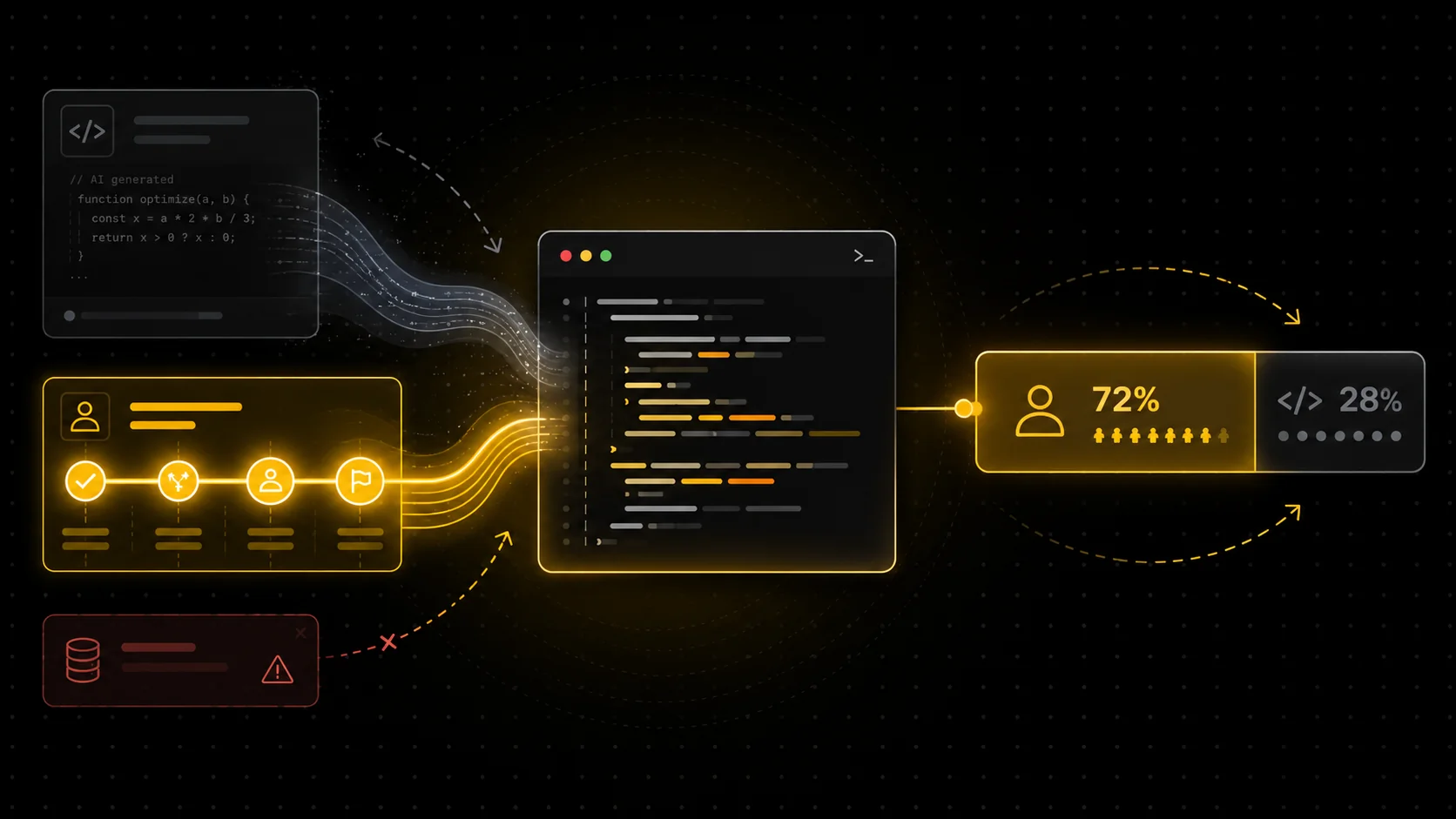
- Make the AI split explicit instead of hiding it. Counterintuitively, the most credible developers in 2026 are not the ones claiming zero AI involvement. They are the ones who can say "the agent scaffolded the CRUD, I designed the data model and hardened the edge cases" and back it up. An honest attribution is both more believable and more impressive than a brittle pretense that nothing was generated.
The first three you can do by hand today. The fourth and fifth are where people stall, because no human reliably logs their own timeline, and reconstructing the human-versus-generated split from memory is the one thing that reads as fabricated.
The tells that prove nothing
Some of the standard advice actively backfires, and being blunt about it saves you from leaning on signals a skeptic will dismiss in seconds.
A green-square contribution graph is the classic false positive. It shows activity happened, not that the activity was meaningful or human-driven, and it is paddable in minutes by a script, which is why it functions as a claim wearing the costume of evidence. For the full mechanics, see why GitHub green squares do not prove the work.
AI-detection scores are the trap specific to this question. They feel like the obvious tool and they are the weakest link in any argument, because they are gameable in both directions and carry no accountability. If your case for human authorship rests on a detector's percentage, you have handed your credibility to a coin flip. Tools in this space, like GitClear on the code-quality and AI-code research side or Tokscale on the agent token-and-cost side, can tell you useful things about how much was generated or what the agents spent, but measuring AI involvement is not the same as proving the human share, and neither a quality delta nor a token count attributes the driving to a person.
A polished portfolio site has the resume's flaw: it presents a curated result and verifies nothing about who produced it or how. It is a fine introduction and a poor proof.
Where DevClocked fits
Full disclosure: I build DevClocked, so read this as the founder telling you what it is for, not a neutral ranking. DevClocked exists to make the strongest proof layers, the captured timeline and the human-versus-AI attribution, something you do not have to manufacture by hand. It measures what you and your AI agents actually shipped in terms of leverage and output, not raw minutes in an editor, and turns it into a profile that shows your real work over time, audited to source. The mechanism is a git baseline crossed with lightweight telemetry from an editor extension and an editor-agnostic CLI that also sees terminal and agent sessions like Claude Code, Cursor, and Codex, with a model learning the relationship between the two so the record is calibrated rather than guessed. That combination is what lets it speak to what was yours versus generated, which a contribution graph or a detector score cannot. The deeper version of this argument lives in how to prove you wrote the code, and the underlying measurement is explained here.
It would be dishonest to pretend you always need this. In a live technical interview where you genuinely drove the work, your own explanation of the decisions beats any tool, full stop. If you have not shipped anything yet, there is nothing to audit and you should build first. A plain git history plus the ability to defend your own code carries plenty of situations on its own. DevClocked earns its place when the work is real, the AI share is non-trivial, and you are tired of human authorship being something you can only assert. This is the same claims-versus-proof problem the whole product sits on, just at its sharpest point, because AI made authorship the one credential that used to be automatic.
Related Guides
- How to prove you wrote the code (not AI): the broader authorship playbook this page narrows down.
- Prove what you shipped: the case for audited developer work: the claims-versus-proof argument underneath all of it.
- Why GitHub green squares do not prove the work: the mechanics of the most common false signal.
- Track coding time from git: how the underlying measurement actually works.