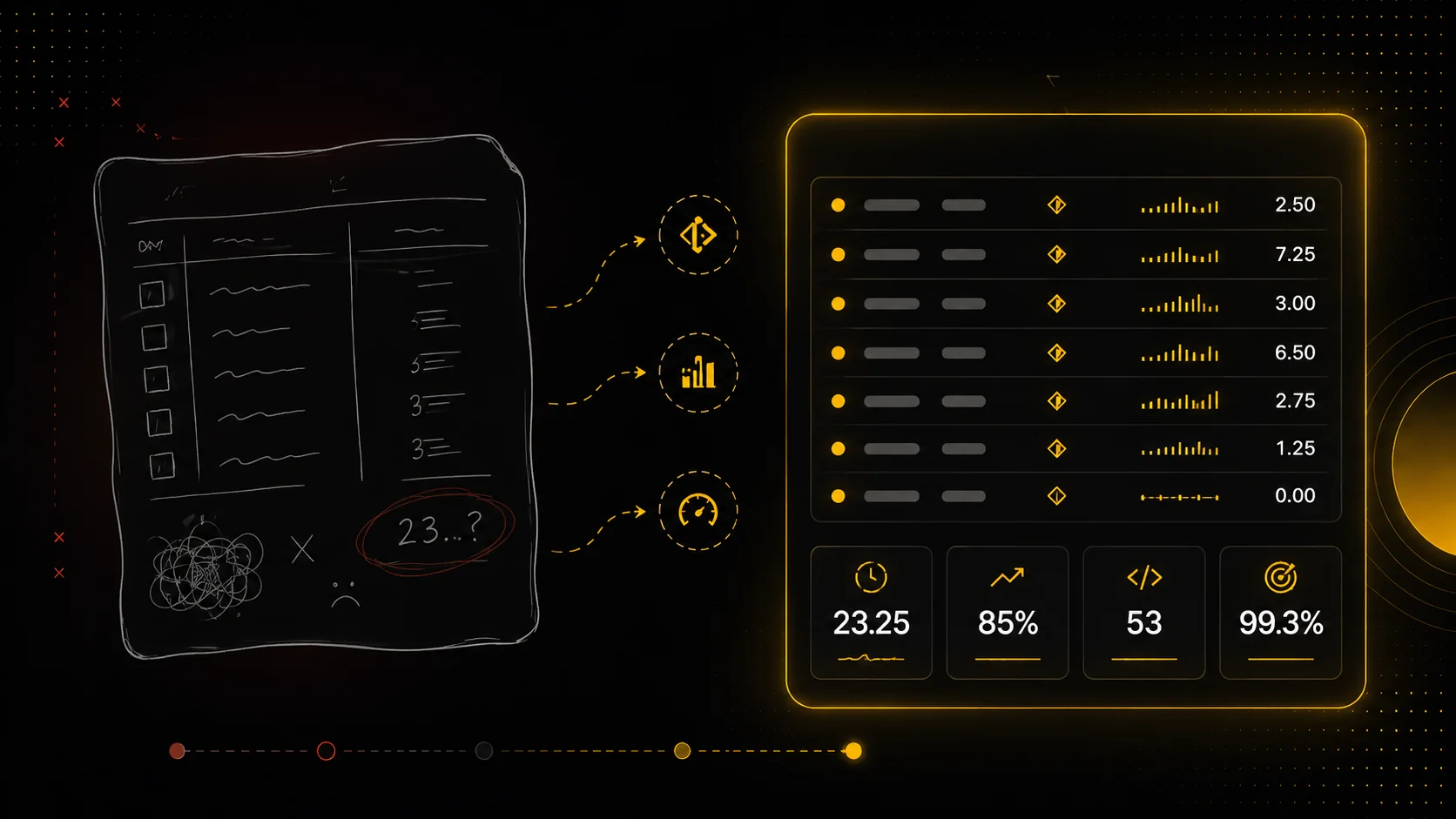
The Friday-afternoon fiction
At the end of most weeks, a developer sits in front of a blank timesheet and tries to remember what they did on Tuesday. What comes out is not a record, it is a reconstruction, and reconstructions are shaped by what was memorable rather than what was true. The hard debugging session that felt endless gets inflated. The three small tasks that quietly ate the morning get forgotten. The "quick fix" that actually took three hours gets logged as thirty minutes because that is how long it should have taken.
Quick Answer
Manual timesheets are inaccurate because they are built from memory, and human memory is bad at time. Research on time estimation has found people's estimates off by roughly 40% on average, and developers skew toward overestimating hard tasks and forgetting routine ones. The result is a weekly creative-writing exercise that distorts billing, planning, and your sense of where time goes. The fix is to stop reconstructing hours from memory and capture them automatically. Git-based tracking reads your real activity, your commits and the work around them, and reconstructs honest hours with no timer to start. Here is why memory fails and what the accurate alternative looks like.
None of this is dishonesty. It is how memory works. We encode effort and difficulty, not elapsed time, so the timesheet ends up measuring how things felt rather than how long they took. If you have ever filled one in and known, even as you typed, that the numbers were rough, this is why.
The memory problem, specifically
Human memory was not built for time accounting. People consistently overestimate time on challenging or interrupted tasks and underestimate routine work, and studies of time estimation have put the average error around 40%. That is not a rounding issue. A number that is wrong by close to half is not a measurement, it is a guess wearing a measurement's clothes.
For developers the distortions are predictable. Debugging feels longer than it was. Meetings expand in memory to fill the space they occupied. Small tasks vanish entirely. And the genuinely deep work, the long quiet stretches where the real progress happened, is often the hardest to reconstruct because you were too absorbed to clock it. The net effect is a timesheet that is confidently wrong in several directions at once.
What the inaccuracy actually costs
It is tempting to treat this as harmless, but inaccurate time data is expensive in ways that compound. The obvious cost is billing: when hours are reconstructed from memory, you are either under-billing real work or over-billing in a way that will not survive a client questioning it. Neither is a good place to be, and for freelancers and agencies it adds up fast.
The quieter cost is that you cannot reason about your own work. Without accurate data you cannot see your real productivity patterns, you cannot estimate future work with any confidence, and you cannot tell whether a new tool or process actually helped. You are making decisions about how you spend your most valuable hours based on numbers you half-invented. This is the real damage: not just a wrong invoice, but a distorted picture of your own working life.
The automatic, git-based alternative
The fix is to stop asking memory to do a job it cannot do. Instead of reconstructing hours after the fact, a git-based tracker reads the record your work already leaves behind. Your commits are timestamped, your activity has a shape, and from that a tool can reconstruct your actual working sessions and attribute them to the right project, with no timer to start and nothing to remember.
This is exactly where automatic tracking beats manual tracking: it never forgets, it is not swayed by how a task felt, and it is honest about gaps. A common and slightly uncomfortable discovery is that you code less than you thought, because the inflated estimates collapse to real numbers, while the deep sessions you barely noticed finally show up. For how the inference works, see how to track coding time from git, and for turning those honest hours into client bills, developer time tracking for invoicing.
There is a 2026 wrinkle worth naming. As more work moves into terminal and agentic sessions, manual timesheets get even less accurate, because that work is fast, bursty, and easy to forget. A git-based tool paired with a CLI tracker captures it, where memory and a timer you never started capture nothing.
Where DevClocked fits
DevClocked replaces the memory-based timesheet with hours derived from your actual work. It tracks passively from git activity and a CLI tracker, reconstructs your sessions, and gives you a record accurate enough to bill from and honest enough to plan with. Because the same trail is auditable, the hours are not just a number you assert, they are something you can stand behind if a client or manager asks.
It is not the right tool for everything, and it is worth being clear. If you need to log non-coding work, meetings, calls, admin, in the same timesheet, a general manual tracker will cover that and a git-based tool will not. And if your work does not live in git, there is little for it to read. DevClocked earns its place when your billable or trackable work is code, and you are done turning Friday-afternoon memory into numbers you quietly do not trust.
Related Guides
- How to track coding time from git: the accurate, no-timer alternative explained.
- Estimate developer hours from commits: turning git history into defensible hours.
- Developer time tracking for invoicing: billing clients from real coding hours.
- 9 best time tracking tools for developers: automatic versus manual options compared.