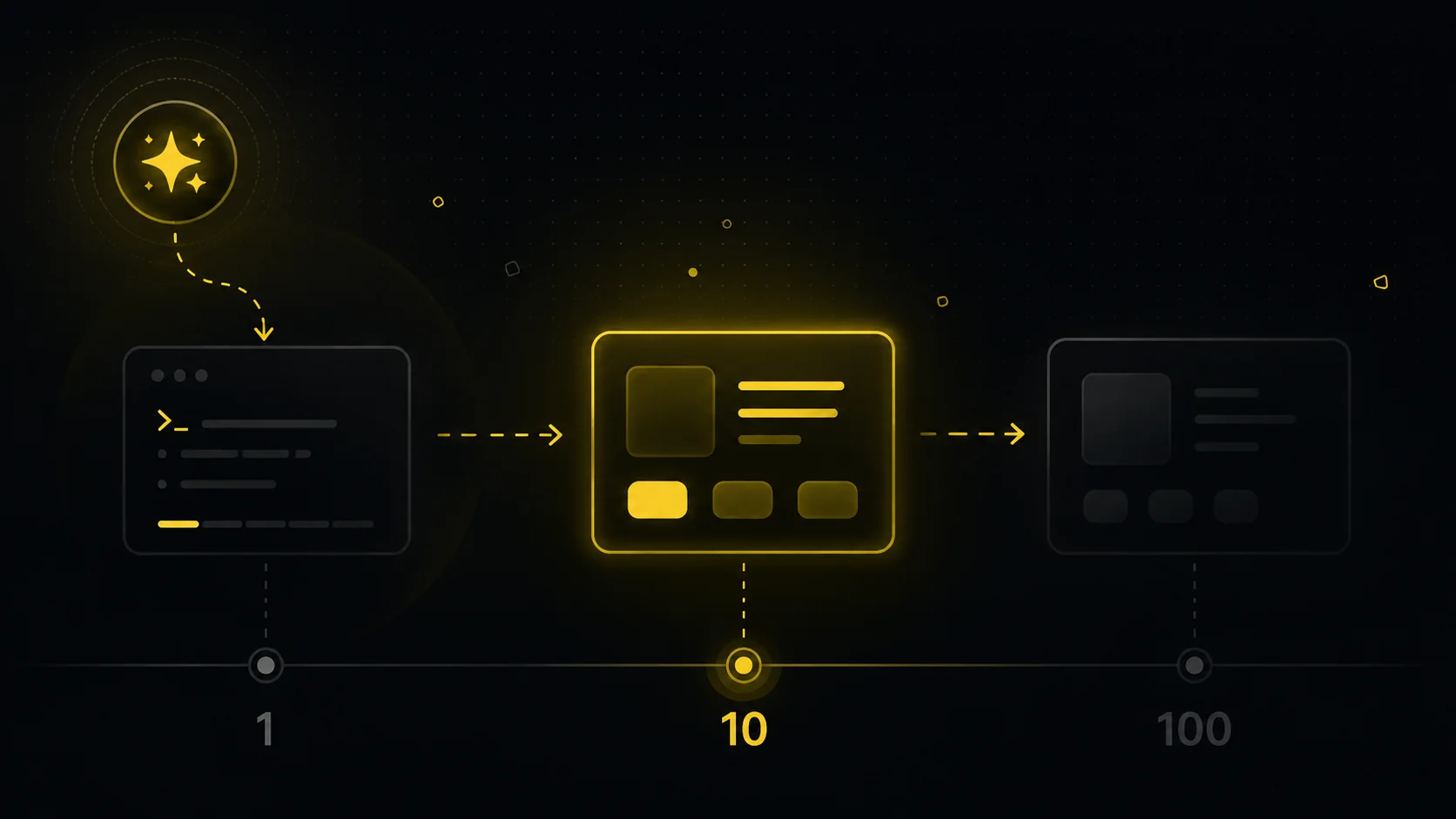
Why the honest answer is still a range
Most people asking this are either sanity-checking an agency quote or planning their own runway. Both deserve a straight answer, and the straight answer is that the timeline depends on three things: scope, who is building, and how heavily they lean on AI.
Quick Answer
With AI coding tools like Claude, Cursor, and Codex now doing most of the typing, a working MVP takes 2 to 8 weeks for an experienced builder, down from the 2 to 4 months it used to take. A proof of concept can come together in a couple of days. A usable, unpolished MVP with real core functionality is realistic in 2 to 4 weeks, even part-time. A polished, billing-ready product is still months away. AI compressed the coding, not the thinking, the integrations, or the hardening. Below are honest ranges by app type, a real build I tracked end to end, where the time actually goes now, and why "I built this in two weeks with AI" has become a claim worth proving.
The word "MVP" hides a lot. The same idea can be a weekend prototype or a four-month build with auth, billing, and an admin panel. When someone says an MVP takes "about three months," they have quietly assumed a scope you may not share. This is why two founders building what sounds like the same app get estimates that differ by a factor of three. The timeline is set the moment you decide what is in and what is out, long before any code gets written.
AI changed the slope of the line, not the shape of it. The boring, repetitive 70 percent of a build, the part that used to eat the most calendar time, is now fast. What is left is the part AI cannot do for you: deciding what to build, wiring up the integrations that touch the real world, and making the thing survive a stranger using it wrong.
The elephant in the room: building an MVP with AI
If you have opened Cursor or Claude in the last year and watched a feature appear in minutes, you already know the old timelines are gone. It is worth being precise about what actually got faster, because the hype and the reality diverge quickly.
AI is genuinely fast at the things that used to be slow grind. Scaffolding a project, writing CRUD endpoints, building forms and screens, translating between a database schema and an API, and getting a first version of a feature working in the happy path. In practice this is most of what a thin MVP is made of, which is why proofs of concept now appear in days instead of weeks.
AI is not fast at the things that were always the real work. It does not decide what to build for you. It still needs a human to wire up and debug the first painful integration with a payments or auth provider, because that is where real-world mess lives. And it gets a feature 80 percent working quickly, then leaves you the last 20 percent, the edge cases and error states that separate a demo from something a user can trust. This is usually the point where founders feel like the build "stalled," when really it just hit the part AI does not finish for you.
So the honest picture for 2026 is this: AI roughly halves the calendar time to a usable MVP for someone who already knows how to build, and it lets a solo builder cover ground that used to need a small team. It does much less for someone who cannot yet tell when the AI is wrong.
A real build I tracked: Project A, end to end with AI
I built Project A, an iOS app for aquarium keepers, almost entirely with AI assistance, and I tracked the whole thing. It is the most honest data point I can give you, because I am not estimating it, I lived it.
The proof of concept took two days. Enough to prove the core idea worked and that the app could do the one thing it needed to do. The MVP took about two weeks of calendar time, and I want to be precise about what "two weeks" means, because this is exactly where timelines get misrepresented. It was not two weeks full time. It was light coding a couple of evenings a week, plus two full weekends where I went deep. The AI did the heavy lifting on the code while I drove direction, caught the things it got wrong, and made the calls it could not.
And it was not polished. There was no website, just a landing page. The functionality was basic: add a tank, log the essentials, the core loop and not much more. That is the part most "I shipped an MVP in two weeks" posts leave out. Viable, yes. Finished, no. The polish, the website, the edge cases, and everything that makes it feel like a real product was still ahead of me.
This is what an AI-assisted MVP actually looks like in 2026. Fast to a working core, genuinely achievable solo and part-time, and nowhere near done. The speed is real. So is the gap between the MVP and the product.
How long an MVP takes by app type
These ranges assume an experienced builder leaning on AI tools, working steadily, with the scope held still. They are calendar estimates for a clean, usable first version a real user could try, the Project A kind of MVP, not a polished v1. If the spec is still moving or you are still learning to build, pad them by 30 to 50 percent.
| MVP type | Example | Solo + AI (experienced) | Small team + AI |
|---|---|---|---|
| Static / waitlist | Landing page, email capture | 1 to 3 days | 1 to 2 days |
| Single-purpose tool | Calculator, generator, simple iOS app | 3 to 10 days | 3 to 7 days |
| CRUD app, no payments | Tracker, internal tool (Project A's tier) | 1 to 3 weeks | 1 to 2 weeks |
| SaaS with auth + billing | Subscription web app + dashboard | 4 to 8 weeks | 3 to 6 weeks |
| Marketplace / two-sided | Buyers, sellers, payments, trust | 8 to 14 weeks | 6 to 10 weeks |
| AI-feature product | App built around a model + eval loop | 5 to 10 weeks | 4 to 8 weeks |
You will notice the team column is not three times faster than solo. AI narrowed that gap further, because a solo builder with Claude or Cursor now has a lot of the leverage a small team used to provide, without the coordination cost. For a true MVP, one strong builder plus AI is often the fastest path that exists in 2026.
Where the weeks actually go now
Founders picture the timeline as weeks of feature-building. Even with AI, the features are rarely the slow part. The time goes into the work around them, and AI moved the bottleneck rather than removing it.
The boring foundation still takes real time: accounts, auth, the database, deployment, and the first integration with a payment or email provider. AI helps here, but you are still the one debugging why the webhook does not fire. Almost always, this plumbing is a third of the build.
Decisions are now the biggest unautomated cost. Which framework, which data model, what to cut from scope. AI will happily build whatever you ask, which means the quality of your build is capped by the quality of your decisions. A vague instruction produces a confident, wrong result fast. This is what actually separates a two-week AI build from a two-month one: not typing speed, but knowing what to ask for.
Then there is the long tail of "done." AI gets you a working happy path quickly. Making it survive real input, errors, and a stranger using it wrong is the rest of the time, and AI helps less here than anywhere else. This is the real reason AI-assisted estimates still slip. The visible work got faster, so people assume the whole thing did, and the invisible work is now a bigger share of what remains.
You can describe velocity, or you can show it
Here is the uncomfortable part, and AI made it sharper. When a person says "I built this MVP in two weeks," that is a claim. When AI wrote a lot of the code, it is a claim with two soft spots: how long did it really take, and how much of it did you actually drive? "Two weeks" can quietly mean two full-time weeks or, like my Project A build, a couple of evenings and two weekends. Those are very different things, and a sentence cannot tell them apart.
What settles it is the record of the work itself: when the commits landed, how the effort was spread across days, which AI sessions produced what, and how a feature moved from started to shipped. A timeline you can inspect answers the question a status update only gestures at. In the AI era this matters more, not less, because the work being fast makes the claims easier to inflate and harder to verify. For a build, as for a developer's skill, the proof is in the trail of work, not the summary of it.
Where DevClocked fits
This is the exact problem DevClocked exists for. It tracks AI-assisted building, the Claude, Cursor, and Codex work alongside the commits, and turns it into an audited timeline you can show. If you are a solo founder building in public, or showing investors momentum without staging a demo, an inspectable record of a two-week AI build is a far stronger signal than an update email, because nobody has to take your word for the speed or the authorship. If I had wanted to prove the Project A timeline to anyone, this is what I would have pointed them at.
Be honest about when you do not need it, though. If you are building alone on a weekend toy with no one to report to, a private notebook is fine and a tracked timeline is just overhead. If your team already lives in a shared board everyone trusts and your investors are happy, you do not need another surface. DevClocked earns its place specifically when someone outside your head needs to believe an AI-assisted build is real, fast, and yours, and a claim is not enough. That is the case it is built for.
Common mistakes when estimating an AI-built MVP
The first mistake is trusting the demo. AI gets you to an impressive happy path fast, which feels like "almost done." The edge cases, error states, and real-world mess are most of the remaining work, and they are the part AI finishes least.
The second is estimating the features and forgetting the foundation. Add the setup, the integrations, and the hardening, and most honest AI-assisted estimates still roughly double from the feature-only guess.
The third is treating "MVP" as a quality bar instead of a scope cut. Viable does not mean polished. My Project A MVP had no website and basic functions, and that was the right call. Shipping the core fast and adding polish later is the whole point.
The fourth is confusing AI output with progress. A tool can be generating code all day while the product goes nowhere, because the direction was wrong. The only way to know the difference is to look at what actually ships over time, not how much was generated.
Related Guides
- Track where your build time actually goes: the foundation guide for understanding your own velocity.
- How to prove you wrote the code in the AI era: the authorship question this article raises, answered in full.
- How long should a feature take to build?: benchmarks one level down from the whole MVP.
- Is my dev team actually shipping?: reading progress from work, not status updates.
- What is build velocity?: the term, and how to measure it honestly.